

ANNOUNCEMENTS
Getting Ahead of Burnout: A Conversation with Jordana Bergman
Aug 28th, 2026
Burnout in law almost never looks like breakdown. It looks like someone who still hits every deadline and answers every email, whose work nobody would call weak, but for whom focus takes more effort than it used to. Patience runs shorter. Rest happens and doesn't restore much. To everyone else, they look fine.
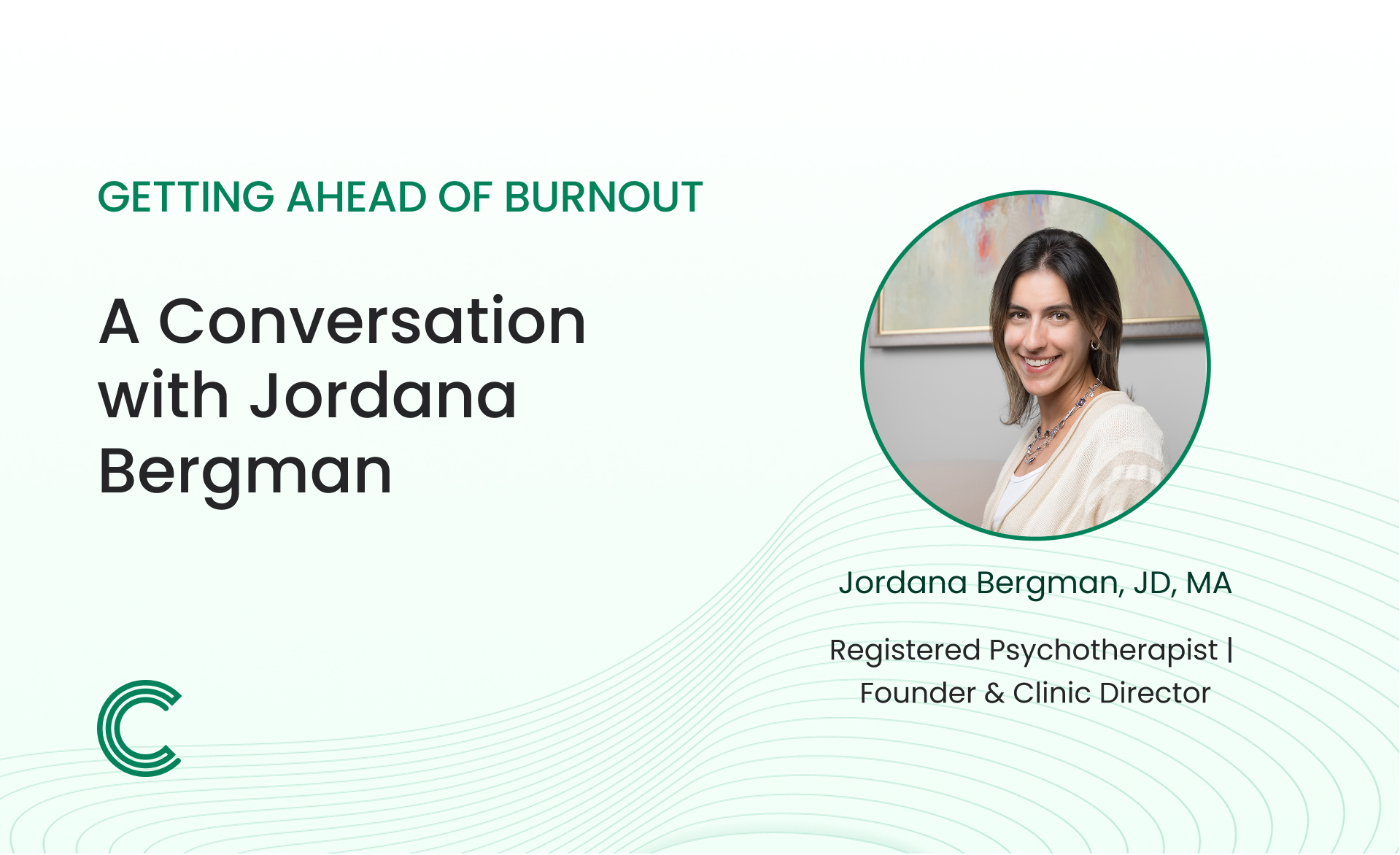
This past May, Closer welcomed Jordana Bergman, registered psychotherapist, former litigation lawyer, and Founder and Clinic Director of Eden Wellness Psychotherapy, for a conversation about the gap between how someone is really doing and how they appear to be doing.
The World Health Organization defines burnout as a syndrome resulting from "chronic workplace stress that has not been successfully managed." Jordana breaks that into three areas where things shift: energy, connection, and capacity. Energy is the obvious one, the depletion that rest no longer touches. Connection is harder to name, and tends to surface as cynicism, dread, or emotional distance from work you used to care about. Capacity is when the output holds steady but everything behind it costs more.
Getting the distinction right matters, because stress and burnout call for different responses. Stress tends to feel like too much. Burnout tends to feel like not enough. "Stress is often over-engagement. Burnout is disengagement," as Jordana puts it. A lighter week helps ordinary stress. Come back from a holiday to the same mismatch of high demand and thin recovery, though, and the break turns out to have been a pause rather than a fix.
Why it hides so well in legal work
Jordana calls it the mask of high-functioning presentation. The emails get answered and the deadlines get met while the internal cost climbs quietly. "Sometimes it can look like competence without any joy," she says. Reduced efficacy might mean rereading the same paragraph ten times, or second-guessing decisions you would have made easily a year ago, even when your work product has not changed.
Early signs are quieter than most people expect. Less patience. Fewer jokes. More effort for the same result. Because those signs are so widespread in the profession, they stop registering as signs at all, and strain that becomes normal and then expected gets filed under "this is just my job." The useful question is not whether you are still performing. As Jordana frames it, "the question really is, what is performance costing you?"
Where it comes from
Burnout becomes likely when demands outrun resources for too long. Most people enter law expecting hard, high-volume work, so difficulty on its own explains little. What does the damage is workload without recovery, responsibility without control, urgency without time to think, emotional labour without emotional support, and high standards without room to be human. Jordana points to six places that mismatch tends to surface: workload, control, reward, community, fairness, and values.
The Canadian numbers back this up. More than half of legal professionals in this country report psychological distress and burnout, with higher rates of depression and anxiety, and the risk concentrates among early-career lawyers and articling students, professionals aged 26 to 35, women, LGBTQ2S+ professionals, and lawyers with disabilities. Jordana treats that data as validation, since these experiences are documented rather than imagined, and as direction, since the causes sit partly outside any one person. "We do not want to imply that the solution to systemic overload is simply better breathing," she says.
Awareness, acceptance, action
Jordana's framework for responding runs in three parts, and the order matters more than it looks. Awareness comes first, which means noticing that something has changed and being able to put words to it. Acceptance comes next, and for legal professionals it is usually the hardest of the three, because the trained reflex is to cross-examine the need. Is it really that bad? Shouldn't I be able to handle this? Action comes last, and it only works once the first two have done their job. Highly cognitive, action-oriented people, which describes a good portion of the profession, tend to skip ahead and go straight to fixing.
Realistic beats performative here. The steps worth starting with are deliberately small:
- Protect recovery on purpose, and ask what actually restores you rather than what only numbs you
- Set clearer limits around availability where limits are possible
- Use brief reset points during the day to interrupt constant activation
- Notice where pushing through has become automatic
None of this substitutes for structural change. Self-support cannot resolve chronic overload, unrealistic expectations, or a workplace that does not feel safe, and Jordana is direct about that limit: "A strong professional is not someone who never needs support."
If any of this sounds familiar
One practice worth trying costs two minutes at the end of the workday. Four questions: What depleted me today? What restored me today? What sign of strain did I notice? What is one thing I need tomorrow? The point is earlier recognition rather than perfection. In her words, "burnout prevention is small, repeated acts of honesty and protection."
There is a great deal more to say about how burnout takes hold, how to spot it in yourself and the people you work with, and what actually helps once you do.
Request the recording to view the live session: https://www.closer.ca/events
About the speaker
Jordana Bergman, JD, MA Founder and Clinic Director, Eden Wellness Psychotherapy
Jordana practiced litigation at a Bay Street firm before moving into legal career counselling at Osgoode Hall Law School and then into clinical work. She now supports lawyers and other high-performing professionals through burnout, anxiety, and trauma, and she teaches mental health, wellness, and the legal profession as adjunct faculty at Osgoode Hall. Her view of the profession comes from the inside and from the clinical side at once.
Get in touch: jordana@edenwellness.ca | www.edenwellness.ca